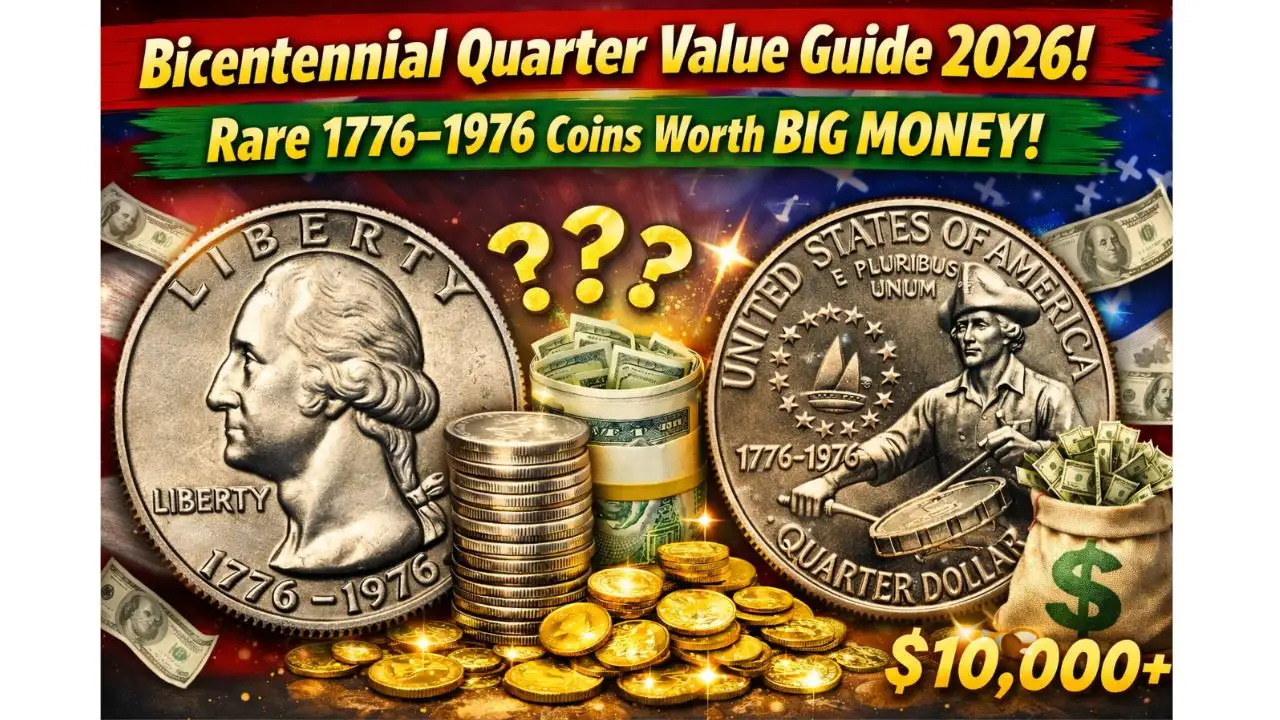
As 2026 rolls around—exactly 50 years after those special quarters first circulated for America’s 200th birthday—plenty of folks are dusting off old coin jars and checking their pockets. You might have one of these 1776-1976 Bicentennial quarters sitting in a drawer right now.
Most are still just face value, but certain rare versions, high-grade examples, and error coins are pulling in serious money from collectors. Whether you’re a casual finder or a serious hobbyist, this straightforward guide breaks down what to look for and what your coins could actually be worth today.
The Story Behind These Patriotic Coins
The U.S. Mint created the Bicentennial quarter to mark two centuries since the Declaration of Independence. Production kicked off in 1975, but every coin carries the dual date 1776-1976 so regular-dated quarters wouldn’t get hoarded. Over 1.6 billion pieces rolled out, mostly from Philadelphia (no mint mark) and Denver (D mint mark) for everyday circulation in the standard copper-nickel clad composition. San Francisco handled the collector versions—both clad proofs and the special 40% silver uncirculated and proof strikes. Designer Jack L. Ahr gave the reverse a colonial drummer boy with a victory torch and 13 stars, making it one of the most memorable modern U.S. coin designs ever.
Everyday Bicentennial Quarters and Their Value in 2026
If your quarter shows heavy wear and has either no mint mark or a small “D,” it’s almost certainly worth just 25 cents in circulated condition. That covers the vast majority out there. But pull out a bright, uncirculated example and values climb quickly. Mid-grade Mint State pieces (around MS65) from Philadelphia or Denver typically bring $5 to $10 on today’s market. Step up to MS67 and you’re looking at $30 to $100 depending on eye appeal and strike quality. Denver coins often have a slightly sharper look, which collectors pay a small premium for. In top certified grades like MS68, prices can jump into the thousands for the very best examples.
Here’s a quick look at typical market ranges for common clad versions as of early 2026:
| Type | Circulated | Uncirculated (MS65) | High Grade (MS67+) |
|---|---|---|---|
| Philadelphia Clad | $0.25 | $5–$10 | $50–$150+ |
| Denver Clad | $0.25 | $5–$12 | $60–$200+ |
| Clad Proof (S) | N/A | N/A | $10–$80 (PR70) |
Identifying the Silver Ones That Shine Brighter
The real standouts are the San Francisco silver-clad quarters marked with an “S.” These contain 40% actual silver (about 0.148 ounces pure), so they weigh a touch more—5.75 grams versus 5.67 for regular clad—and the edge looks solid silver with no copper stripe. Give one a light tap and it rings higher-pitched than a regular quarter. Uncirculated silver business strikes start around $8 to $20, while proof versions with deep cameo contrast often sell for $15 to $50 in top condition. The absolute cream of the crop—those flawless MS69 or PR70 silver pieces—have brought several hundred to over $19,000 at auction in recent years because so few survived in perfect shape.
Silver versions break down like this in today’s market:
| Type | Typical Value | Top Grade Value |
|---|---|---|
| Silver Uncirculated (S) | $8–$25 | $100–$500+ (MS68+) |
| Silver Proof (S) | $10–$40 | $200–$1,500+ (PR70) |
| High-Grade Silver MS69 | N/A | Up to $19,000+ |
The Rare Errors That Can Make You Rich
Minting mistakes turn ordinary quarters into headline grabbers. The most famous is the 1976-D Doubled Die Obverse, where “LIBERTY,” the date, or “IN GOD WE TRUST” shows clear doubling. Even lower-grade examples can fetch $200 to $1,000, while sharp, high-grade ones have sold for several thousand. Other hot errors include off-center strikes (10-50% off with date visible), clipped planchets, and struck-through pieces. One dramatic full brockage error brought $40,000 at auction not long ago. Always examine your coins under good light or with a loupe—the doubling jumps out once you know what to spot.
How to Check Your Coins and Cash In During 2026
Start simple: look for the mint mark (none, D, or S), check the edge for silver, and scan for doubling or odd strikes. A digital scale and magnet test can confirm silver content too. If anything looks special, send it to PCGS or NGC for professional grading—that certification often doubles or triples what you’ll get. With the 50th anniversary of these coins creating fresh buzz right now, coin shops, online marketplaces like eBay, and major auctions are all seeing strong demand. Just avoid cleaning any coin; it kills the value instantly. Dig through that spare change this weekend—you never know, one of those drummer boys might just pay for your next family vacation.
Whether you find a common keeper or a true rarity, these Bicentennial quarters remind us why coin collecting stays so much fun. Happy hunting in 2026, and may your next pocket find turn out to be the big one everyone dreams about.